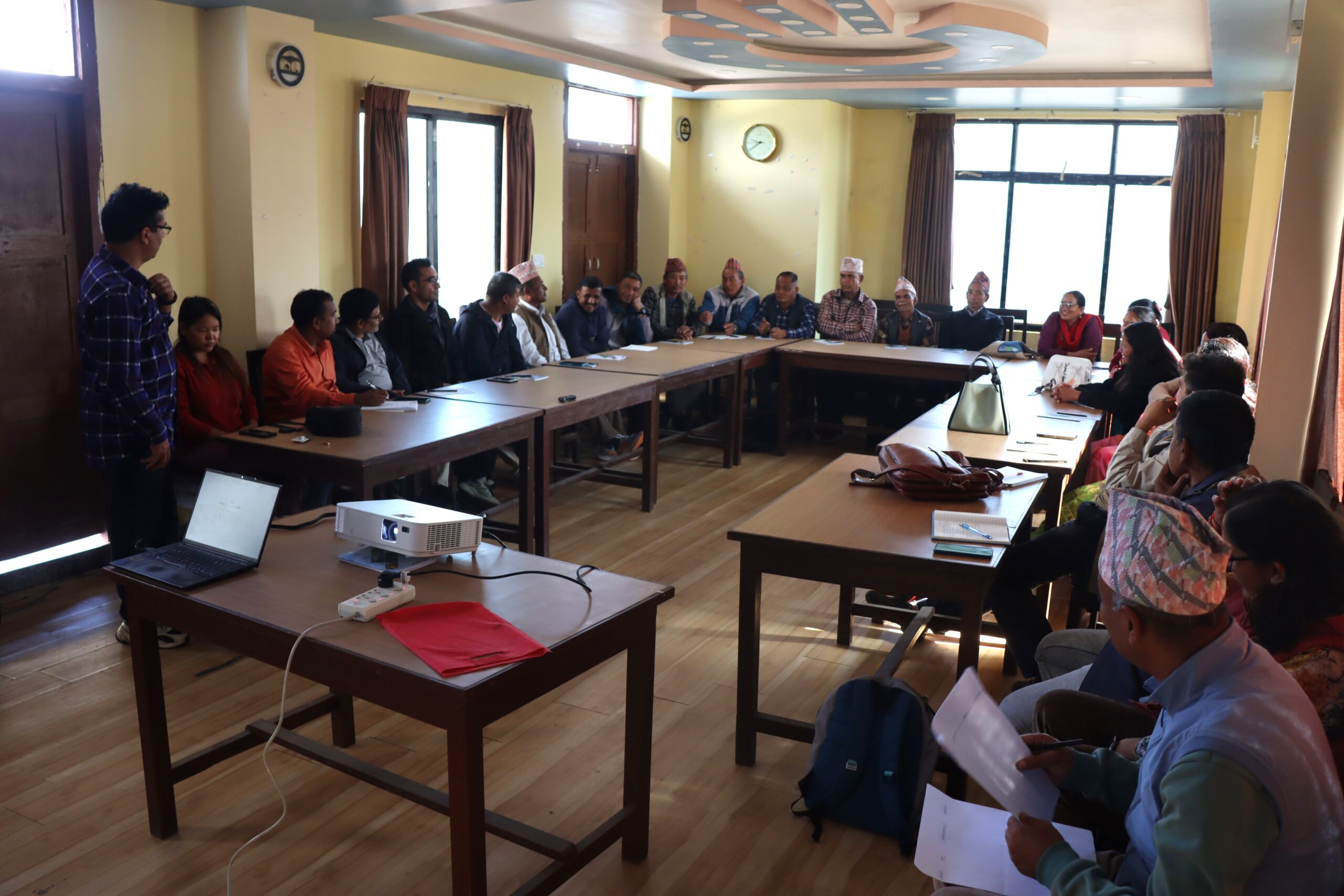
Southasia Institute of Advanced Studies (SIAS) organized another insightful session of the Future Himalayan Research Seminar (FHRS) on 11 December 2025, on “Community-Led Climate Change Adaptation Strategies: Proactive Measures and Key Determinants.”
The session featured Dr. Kumar Darjee, Research Fellow at SIAS, who presented his doctoral research examining how communities across Nepal perceive climate risks, how these perceptions shape adaptive behaviors, and what these insights mean for broader climate governance. The seminar brought together researchers, practitioners, and students both onsite and virtually, fostering a rich exchange of ideas grounded in local realities.
The session began with opening remarks by Dr. Gyanu Maskey, who welcomed participants and introduced the presenter. She highlighted Dr. Darjee’s extensive academic and professional background, including his PhD in Natural Science from the University of Hamburg and academic training in forestry, humanities and social sciences, and psychology.
Dr. Darjee’s presentation centered on the key components of his PhD research, conducted across Nepal’s Mountain, Mid-Hill, and Lowland regions. Using over 500 household surveys and complementary meteorological data, his work distinguishes between proactive and reactive adaptation measures, an analytical approach that helps in examining how communities respond to climate variability and long-term risks. He emphasized that although climate change is a global phenomenon, its impacts are felt locally and unevenly. Geographic vulnerability, socio-economic conditions, livelihood systems, and access to resources strongly shape both climate risk perceptions and adaptation behaviours.
While scientific evidence confirms rising temperatures and increasing rainfall variability, Dr. Darjee stressed that community experiences often provide nuance beyond what datasets capture. His analysis revealed that temperature increases are more pronounced in mountain regions across all seasons, and rainfall patterns show high variability even where long-term statistical trends are less clear. Local perceptions of climatic changes vary by region and livelihood, reflecting how people interpret risks through their lived experiences.
To better understand how people interpret climate risks, Dr. Darjee employed a Social Cognitive Model that examined perceived climate impacts, risk interpretation, self-efficacy, intentions to act, and decision-making processes. This framework illuminated how psychological, environmental, and socio-cultural factors interact to shape adaptation decisions. One of the study’s significant contributions is the documentation of more than 50 adaptation measures practiced across Nepal, spanning agriculture, water management, livestock, disaster risk reduction, and livelihood diversification. Agricultural diversification emerged as a widely adopted proactive strategy, with farmers shifting cropping patterns, choosing drought-resilient varieties, and adjusting cultivation timelines. Livestock-related adjustments such as transitioning from large animals to poultry or shifting from traditional crops to cardamom demonstrated households’ efforts to navigate uncertainty through livelihood modification. Over 30 percent of the identified measures were related to disaster risk reduction, including slope stabilization, drainage improvements, and early warning initiatives. Adoption of solar energy, biogas, and clean cooking technologies also illustrated how many proactive measures serve dual roles by supporting both adaptation and mitigation goals.
The study further identified several determinants influencing households’ ability and willingness to engage in proactive adaptation. These included the number of livelihood options, socio-economic status, land ownership, geographic setting, existing knowledge, past adaptation experience, and gender and social inclusion dynamics. Households with diversified livelihoods, greater resources, and exposure to climate discussions tended to take more proactive actions, while those with fewer resources often had to rely on reactive responses. This disparity highlights the need for targeted support to enable vulnerable groups to adopt forward-looking strategies.
Dr. Darjee also drew attention to persistent policy gaps that hinder effective adaptation implementation. He highlighted misalignment between Local Adaptation Plans of Action (LAPA) and community institutions such as Community Forest User Groups, overlapping mandates within local governments, inadequate integration of community knowledge into higher-level planning, and the absence of a clearly defined local “implementing unit” for adaptation actions. Bridging these gaps, he argued, is vital to maximize community-led efforts and strengthen climate governance systems. He concluded with a reflection on maladaptive action and presented an analytical framework that he is currently developing.
The presentation was followed by an engaging discussion among in-person and online participants. Questions touched on the integration of indigenous knowledge into adaptation planning, scaling up proactive adaptation, gender dimensions of climate response, and enhancing the adaptability and responsiveness of local governments. Participants appreciated the empirical depth of Dr. Darjee’s research and its relevance to ongoing policy debates in Nepal.
Overall, the seminar underscored the richness of local knowledge and practices in shaping Nepal’s climate adaptation landscape. Dr. Darjee’s work highlights that community-led actions, although often undervalued, play a crucial role in strengthening resilience and contributing to national and global climate goals. The session concluded with a collective call for stronger policy coherence, enhanced investment in local capacities, and greater recognition of community innovations as essential elements of long-term climate resilience.